← All stories 🌐 IT · PT · EN
Cajamarca, 1533
The furnaces of Cajamarca have been burning for weeks.
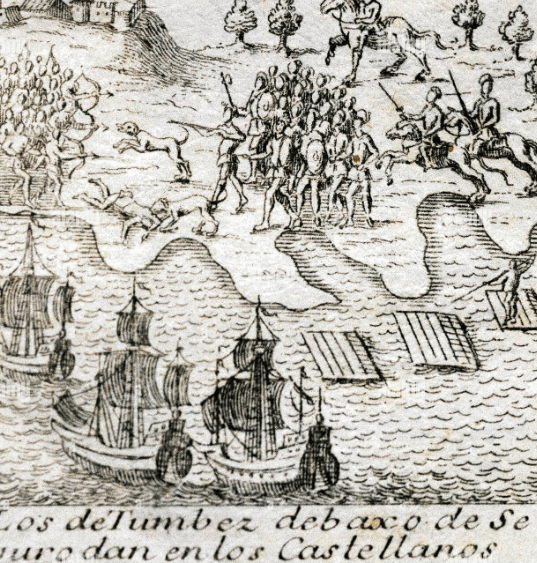
In a room that an Inca emperor filled with gold up to a line drawn on the wall, Spanish smiths are melting temple plates, goblets, llamas and little golden corn cobs into ingots. Nobody is crying over the art. Everybody is counting.
Because the soldiers know one thing for certain: when the melting ends, there will be a division.
And when it comes, it is not a lottery. The royal fifth goes to the Crown first, 262,259 pesos out of 1,326,539 melted. Then the rest is split by rank and by role. Pizarro takes 57,222 pesos of gold and 2,350 marks of silver. His brother Hernando takes 31,080 pesos. De Soto 17,740. Each of the sixty or so horsemen gets around 8,880 pesos and 362 marks of silver. The foot soldiers get half of that, 4,440 pesos and 180 marks.
A horse, in 1533, was a capital investment and a weapon system. It paid double. Nobody in the camp asks why..
We have just described the oldest proportional reward scheme in the history of the Western world, and it was written on the back of a conquest. Not very elegant, I admit. But look at the mechanics: the rule exists before the battle, everybody knows it, and the amount depends on what you brought to the table (a horse, a sword, a command).
Is this a good model for a suggestion program? Hold that thought. We will get there, and we will also meet the guy who arrived late and found the party already over.
The ship that paid for a lifetime
Move the camera to the sea, 1762.
The British frigate Hermione captures a Spanish treasure ship. The prize is worth £519,705. The Royal Navy has a rule for this too, written well before anyone fires a cannon: the prize is divided in fixed shares, and the shares follow the ladder of the ship.
The two captains get £65,000 each. The lieutenants £13,000 each. An ordinary seaman gets £485.
Read it again. A captain earns roughly 134 times a seaman. A bit unfair? Maybe. Yet £485 was real money for a man hauling ropes, and every sailor knew the arithmetic before leaving port.
Notice the trick. The Navy did not pay everybody the same, and it did not pay everybody a pittance. It paid a lot to the few who decided and risked most, and enough to the many to keep them hungry. The rule was public, the prize courts verified the loot, and the ledgers (the “prize books”) were kept. Accounting, in other words, made the whole thing credible.
Cruel, unequal, and perfectly legible. That is the part we can still use.
The man who arrived late
Back in Cajamarca, there is a problem with the happy ending.
Diego de Almagro arrives with reinforcements when the ransom is already collected. His men did not stand in the square, did not take the risk, and by the rules of the camp they get a much smaller share. Which is fair, on paper. Try to explain it to someone who just crossed an ocean and a desert..
Many historians read this resentment as one of the sparks of the long quarrel between Pizarro and Almagro, the one that later ended in civil war among the conquistadors. The lesson is simpler anyway, and it does not need a war to be true.
A proportional reward works only under three conditions:
Known in advance. The rule is announced before the work, not invented at the table.
Applied to everyone. The same formula for the captain and for the cousin of the captain.
Tied to something you can verify. Gold on the scale, a ship in the prize court, a saving in the accounts.
When one of the three breaks, the money does not motivate anybody. It creates an Almagro.
Today: three ways to pay for an idea
Fast forward to our century, where the gold has become a suggestion box and Almagro works in the finance department.
| Who | How they pay | Numbers |
| Washington State | Fixed cash award per accepted idea, per team member | 2025: $9.8M saved, $10,000 per accepting team member |
| Tennessee | Share of verified savings, with a cap | Up to 15% of savings, max $100,000 |
| Toyota | Tiny award for every idea, whatever its size | 500 yen per idea, up to 200,000 yen |
Three models, three philosophies. Washington pays a flat and generous prize when the idea lands. Tennessee is the Cajamarca model: you bring the saving, you get a slice of it. Toyota pays almost nothing, almost always, and counts on the habit.
The lean community loves to argue about this. Mark Graban, on LeanBlog, reports a case where a $20-per-idea scheme at Toyota backfired and argues for keeping incentives small and tied to implementation. John Maurer compares average awards, Japan at $3.88 against the US at $458.
So where is the contradiction with my thesis? There is none, if you read carefully. Small and frequent rewards build the habit. Proportional rewards recognise the people who move the needle. A good system needs both layers: the 500 yen for everybody, and the Tennessee-style slice for the one who saves the plant a million.
And the one who saves the plant a million, rewarded with a flat badge and a handshake, will do the math. Sooner or later. Then he will stop sending ideas, or he will send them to a competitor.
What to do on Monday
So, from the gold room back to the plant floor. If you run a suggestion program, here are three moves.
Two layers. A small, fast reward for every implemented idea, to build the habit. A proportional layer on top, a percentage of verified savings with a cap, for the few ideas that move the needle.
Publish the formula. Percentage, cap, who verifies the saving, how long the saving is measured. Before the first idea arrives, not after.
Close the loop in public. The prize courts of the Royal Navy did not just pay, they recorded. Tell the plant who got what and why.
The cap is the part people fight about, and I understand why. Tennessee stops at $100,000. I would rather argue about the cap than about the principle..
Ps. Pizarro did not need a cap. He wrote the rules, and he also happened to be first in the queue.
-B
Sources
- William H. Prescott, History of the Conquest of Peru (Project Gutenberg)
- Pedro Sancho, An Account of the Conquest of Peru (Project Gutenberg)
- Esteban Mira Caballos, Un botín de leyenda: el rescate de Atahualpa
- Infobae: Atahualpa y el oro del rescate
- Oxford Reference: prize money
- Washington Secretary of State: State Productivity Board approves cash awards
- State of Tennessee: Employee Suggestion Program
- LeanBlog: Toyota, $20 per idea
- Business Excellence: reward improvement


2 thoughts on “Show Me the Money (1533 Edition)”